
Atlas Orthogonal: A Non-Invasive Approach to Correcting Spinal Misalignments
Written & medically reviewed by Dr. Michael St. Louis, D.C.
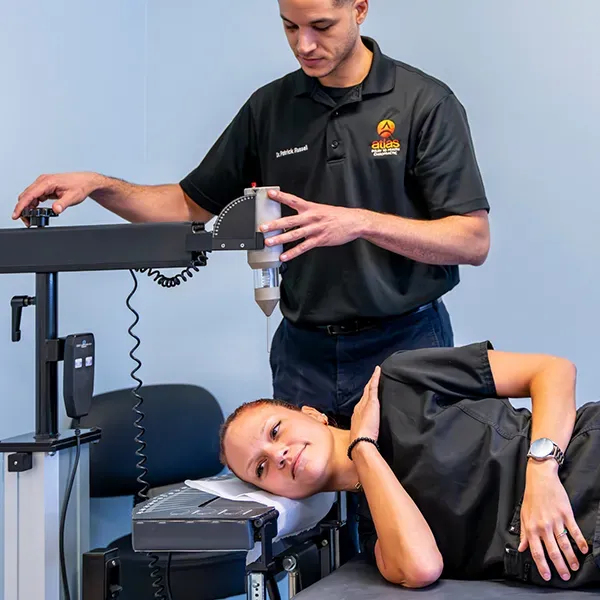
Atlas Orthogonal chiropractic care is a highly precise, non-invasive technique that corrects spinal misalignments — particularly at the topmost vertebra — using a gentle, instrument-based adjustment that requires no forceful twisting, cracking, or manipulation. For patients who have been living with chronic pain, neurological symptoms, or recurring headaches and are searching for a drug-free alternative, this specialized form of upper cervical care offers a compelling, evidence-informed path forward.
This article explains how atlas misalignment develops and how it is corrected. For the service itself, see Atlas Orthogonal chiropractic in Winter Garden and Ocala.
Key Takeaways
- The atlas vertebra (C1) is the keystone of spinal alignment. A misalignment here can create a cascade of compensatory shifts throughout the entire spine.
- Atlas Orthogonal adjustments are feather-light. A calibrated percussion instrument delivers a precise correction measured in fractions of a millimeter — patients often describe feeling almost nothing during the procedure.
- Spinal misalignment is more than a back problem. Because the upper cervical spine houses critical neurological pathways, misalignment can contribute to headaches, vertigo, nerve pain, jaw dysfunction, and more.
- X-rays and 3D imaging guide every correction. No guesswork is involved — your specific anatomy dictates the exact angle and force of the adjustment.
- Many patients experience relief after the first few visits, though individual results depend on the nature, severity, and duration of the misalignment.
What Is Spinal Misalignment — and Why Does It Matter?
Spinal misalignment, also called vertebral subluxation, occurs when one or more vertebrae shift out of their optimal position relative to the bones above and below. The spine is not just a structural column; it is the primary protective housing for your spinal cord and the nerve roots that branch out to every organ, muscle, and tissue in your body.
When vertebrae lose their proper alignment, several problems can develop simultaneously:
- Nerve compression or irritation — displaced bone or surrounding inflammation can impinge on nerve tissue, disrupting signals between the brain and body.
- Altered muscle tone — the muscles that stabilize the spine respond to misalignment by tightening asymmetrically, perpetuating the problem and causing pain and stiffness.
- Disc stress — uneven loading accelerates wear on the intervertebral discs, potentially leading to bulging or herniation over time.
- Compensatory shifts lower in the spine — a misalignment at the top of the cervical spine forces the lumbar spine, pelvis, and even the hips and knees to compensate, which can produce pain far from the original problem site.
The American Chiropractic Association recognizes that spinal health is foundational to overall musculoskeletal wellness, and that conservative, non-invasive approaches should generally be explored before more aggressive interventions.
Why the Atlas Vertebra Is the Most Critical Alignment Point
The atlas (C1) is the first cervical vertebra — a ring-shaped bone that sits at the very top of the spine, directly beneath the skull. Unlike every other vertebra, the atlas has no disc above it and no interlocking facet joints to restrict its motion. This gives it extraordinary mobility, which is precisely what allows you to nod and rotate your head — but it also makes it uniquely vulnerable to misalignment from physical trauma, poor posture habits, repetitive stress, or even the birth process.
The atlas and its neighbor, the axis (C2), surround the brainstem at its lowest portion. The brainstem is responsible for regulating many automatic, life-sustaining functions: heart rate, breathing, balance, and the flow of cerebrospinal fluid. Even a subtle atlas misalignment — sometimes less than a single degree off its ideal position — can place mechanical tension on the brainstem and upper spinal cord, interfering with neurological function in ways that produce symptoms seemingly unrelated to the neck.
This anatomical reality is why correcting an atlas misalignment can have wide-reaching effects on conditions ranging from migraines and vertigo to sciatica and low back pain.
Common Signs You May Have a Spinal Misalignment
Spinal misalignment does not always announce itself with obvious back pain. Some of the most telling signs are subtler:
- One shoulder or hip sitting measurably higher than the other
- Head tilting consistently to one side in photos or when you look in the mirror
- Chronic stiffness or restricted range of motion in the neck or back
- Recurring headaches or migraines without a clear trigger
- Tingling, numbness, or weakness in the arms or legs
- Dizziness or balance problems that have not resolved with standard treatment
- Jaw pain or clicking associated with TMJ dysfunction
- Fatigue or brain fog that seems disproportionate to your lifestyle
Because these symptoms overlap with many other conditions, proper diagnostic imaging is essential before any treatment plan is designed.
How Atlas Orthogonal Chiropractic Specifically Corrects Spinal Misalignment
Step 1: Comprehensive Consultation and History
The process begins with a thorough intake — not just a symptom checklist, but a detailed conversation about your health history, prior injuries (including whiplash, car accident injuries, or sports trauma), lifestyle factors, and prior treatments. This context is critical because the atlas rarely misaligns without a cause.
Step 2: Precision Diagnostic Imaging
Atlas Orthogonal practitioners take a series of specific X-rays — typically three views — to calculate the exact three-dimensional position of the atlas relative to the skull and the axis below it. These images reveal the precise vector (direction) and magnitude (degree) of misalignment. No two patients have identical anatomy, and no two corrections are identical.
Step 3: The Atlas Orthogonal Adjustment
Using an instrument called the Atlas Orthogonal Percussion Instrument, the chiropractor delivers a controlled sound wave directly to the atlas transverse process (a small bony projection on the side of the vertebra). The instrument is calibrated to the exact measurements derived from your imaging. There is no rotation of the neck, no "cracking," and no forceful manual thrust. Patients typically feel a very mild vibration or nothing at all.
Despite its gentleness, the correction is biomechanically effective: the precisely directed force is sufficient to restore the atlas to its neutral position, allowing the surrounding musculature to relax and the nervous system to resume normal communication.
Step 4: Post-Adjustment Rest and Re-Evaluation
After the adjustment, patients rest briefly in a reclined position to allow the body to adapt to its new alignment. Follow-up imaging is used at key points in care to verify that the correction is holding and to refine the approach as needed.
Conditions That Frequently Improve With Upper Cervical Correction
Because the atlas sits at the neurological crossroads of the body, correcting its alignment can support recovery from a broad spectrum of conditions, including:
- Neck pain and headaches
- Pinched nerves and disc injuries
- Vertigo and balance disturbances
- Sciatica and low back pain
- Posture correction and scoliosis-related discomfort
- Neuropathy symptoms in the extremities
- Concussion recovery support
- Spinal stenosis-related pain management
It is important to understand that Atlas Orthogonal care addresses the structural and neurological contributors to these conditions — it is not a cure-all, and it works best as part of a comprehensive, individualized care plan.
Is Atlas Orthogonal Care Safe? Who Is a Good Candidate?
The National Institutes of Health (NIH) broadly recognizes spinal manipulation as a generally safe intervention when performed by a trained professional on appropriate candidates. Atlas Orthogonal takes this a step further by virtually eliminating the mechanical forces associated with traditional high-velocity manipulation, making it suitable for a wider range of patients — including:
- Older adults who may have concerns about bone density or arthritis
- Post-surgical patients seeking conservative care to complement their recovery
- Pregnant individuals experiencing spinal stress as their center of gravity shifts (see our pregnancy chiropractic care page)
- Children and adolescents with postural concerns or sports injuries
- Patients who have had negative experiences with traditional chiropractic adjustments
As with any health intervention, there are contraindications. Patients with certain vascular conditions, active infections, or severe osteoporosis require additional screening. A thorough intake and imaging review ensures that care is appropriate and safe for each individual.
What to Expect During Your First Visit
Your first appointment at Atlas Injury to Health is primarily consultative and diagnostic. You will:
- Share your health history and primary concerns in detail
- Undergo postural and orthopedic assessment
- Receive a set of precise digital X-rays analyzed by your provider
- Discuss your findings and a recommended care plan
Your first adjustment, if appropriate, may occur during that same visit or at a subsequent appointment once imaging has been reviewed. Most patients are surprised by how gentle the process is — and how quickly they begin to notice changes in how their body feels and moves.
MedlinePlus, a resource of the National Library of Medicine, notes that many people with back and neck pain benefit from conservative care before pursuing surgical or pharmaceutical options. Atlas Orthogonal fits squarely within that conservative, patient-centered philosophy.
Frequently Asked Questions
How is Atlas Orthogonal different from regular chiropractic care?
Traditional chiropractic care often uses high-velocity, low-amplitude manual thrusts to adjust multiple spinal segments. Atlas Orthogonal focuses exclusively on the uppermost vertebra (C1) using a calibrated percussion instrument — there is no manual force, no twisting, and no audible "pop." Because correcting the atlas allows the rest of the spine to realign naturally, the effects are often felt from the neck all the way down to the pelvis.
How many visits will I need before I feel better?
This varies considerably depending on how long the misalignment has been present, the degree of structural shift, and your body's individual healing capacity. Some patients notice meaningful improvement within the first one to three visits; others require a longer course of care to achieve and maintain a stable correction. Your provider will outline a realistic, individualized timeline after reviewing your imaging.
Does the adjustment hurt?
The vast majority of patients report feeling very little during the adjustment itself — often just a mild pressure or vibration near the ear. Some patients experience mild soreness in the neck muscles during the first day or two as the body adjusts to a new structural position. This is normal and typically resolves quickly.
Can spinal misalignment come back after it's corrected?
Yes, especially if the underlying causes — such as poor ergonomics, muscle imbalances, or recurrent physical stress — are not addressed. This is why Atlas Orthogonal care typically includes guidance on supportive habits (sleep position, workstation setup, movement patterns) alongside the adjustments themselves. The goal is a correction that holds for increasingly longer periods over time.
Is Atlas Orthogonal covered by insurance?
We are out of network with all health insurance plans and do not bill insurance for payment. You will know the full cost of your recommended care before it begins, and many patients use an HSA or FSA. We can provide documentation you may submit to your carrier yourself. Care following an auto accident is handled separately through Florida PIP.
If you're ready to find out whether spinal misalignment is at the root of your pain, discomfort, or recurring symptoms, we invite you to schedule a consultation with the team at Atlas Injury to Health. With clinics in Winter Garden and Ocala, Florida, Dr. Michael St. Louis and our Atlas Orthogonal practitioners are here to provide a precise, compassionate, and genuinely non-invasive path to better spinal health. Reach out today — your spine (and your whole body) will thank you.
Related Articles
Cranial Facial Release: The Gentle Therapy Most Chiropractors Can't Offer
Cranial facial release is a gentle endonasal balloon therapy that mobilizes cranial bones to relieve sinus pressure, TMJ tension, vertigo, and headaches — a rare, specialized therapy offered at Atlas Injury to Health.
Atlas Orthogonal and Upper Cervical Chiropractic: A Complete Guide
Discover how Atlas Orthogonal upper cervical chiropractic care works, what conditions it treats, and why precision adjustments at the atlas vertebra can restore whole-body health.
Upper Cervical Care: Restoring Balance and Promoting Wellness
Discover how upper cervical chiropractic care targets the atlas and axis vertebrae to restore nervous system balance and support whole-body wellness.
Ready to take the next step?
Schedule a consultation to see how Atlas can help you.
Schedule a Consultation