
Fibromyalgia
Widespread pain, fatigue, and mental fog that testing rarely explains. Gentle upper cervical care and SoftWave therapy address the nervous system and soft-tissue sides of fibromyalgia together.
Common Symptoms
- Widespread muscle pain and aching lasting three months or longer
- Persistent fatigue that rest does not resolve
- Non-restorative sleep — waking unrefreshed regardless of hours slept
- Difficulty with concentration and memory, often described as "fibro fog"
- Tenderness to light pressure across multiple areas of the body
- Morning stiffness
- Headaches, jaw tension, or neck pain occurring alongside the widespread pain
- Symptoms that fluctuate, with flare-ups following stress, poor sleep, or weather change
Common Causes
Fibromyalgia does not have a single identified cause. Clinical understanding points to a combination of contributors:
- Altered central pain processing: The nervous system amplifies signals that would ordinarily register as mild
- Physical trauma: Onset frequently follows a car accident, injury, or surgery
- Upper cervical dysfunction: Disturbed signaling at the top of the spine affects the brainstem regions regulating pain perception and stress response
- Sleep disruption: Poor sleep quality and symptom intensity reinforce each other in both directions
- Prolonged stress: Sustained activation of the body's stress response is a commonly reported precipitant
- Coexisting conditions: Arthritis, thyroid disorders, and other chronic conditions frequently accompany fibromyalgia
How Atlas Treats Fibromyalgia
We address the two contributors that most often go unaddressed — how pain is being processed, and the soft tissue that has absorbed years of guarding.
Advanced diagnostics. A thorough history, postural and neurological screening, and precise digital imaging to identify upper cervical misalignment, plus a review of what has already been investigated.
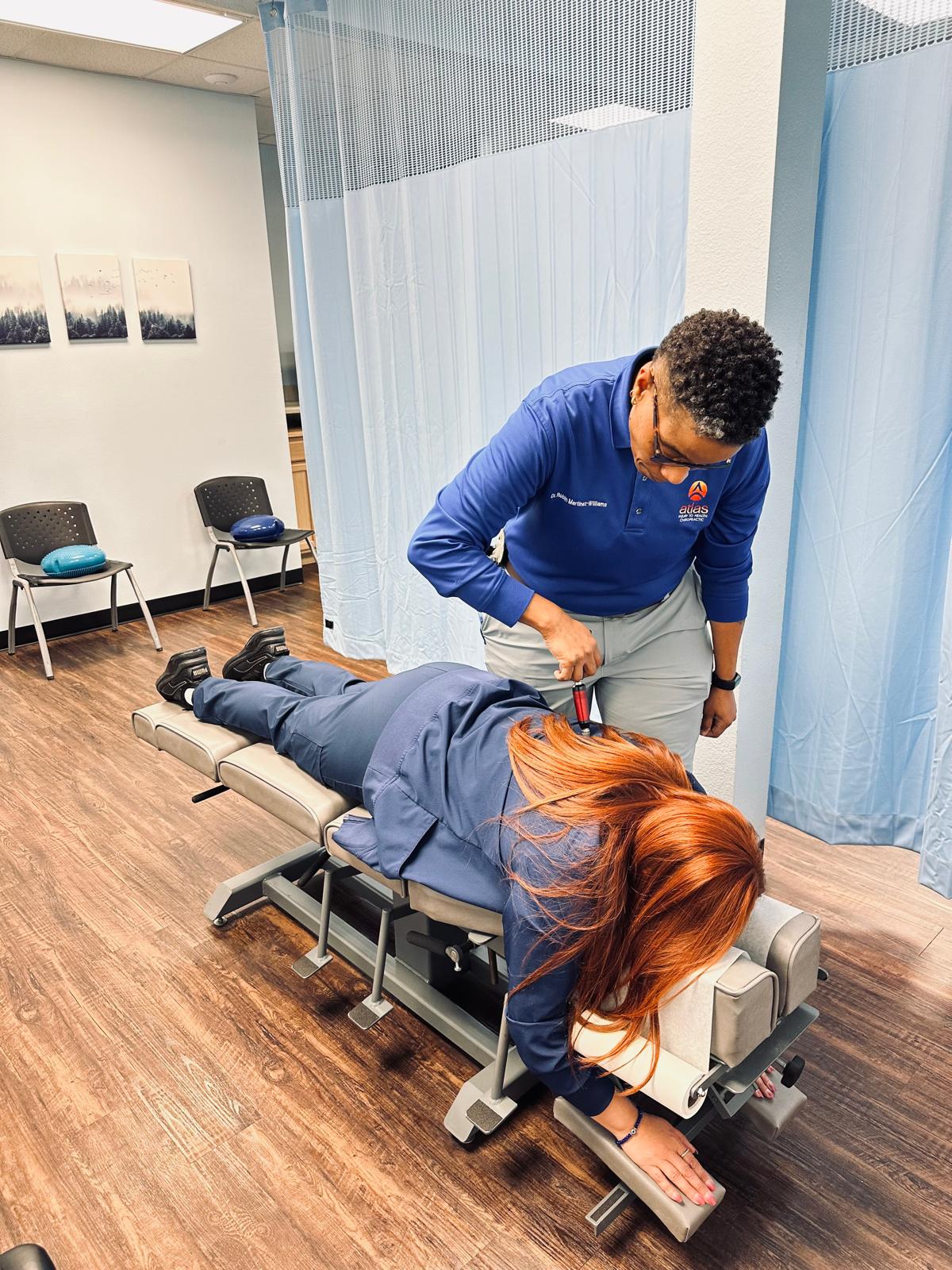
Atlas Orthogonal correction. Instrument-guided, low-force correction of the atlas vertebra. No twisting or forceful manipulation — a deliberate choice for patients whose sensitivity makes conventional adjustment uncomfortable.
SoftWave regenerative therapy. Focused acoustic waves to stimulate circulation and tissue repair in chronically tender regions, without needles or downtime.
Paced, coordinated care. Care is paced to your tolerance and planned around flare-ups, in coordination with the physician or rheumatologist managing your condition — alongside your medical care, never instead of it.
Fibromyalgia is a chronic condition involving widespread musculoskeletal pain, persistent fatigue, disrupted sleep, and difficulty concentrating, and it is understood to involve how the central nervous system processes pain signals rather than damage to the muscles and joints themselves. That distinction is the reason so many people arrive with normal imaging and normal bloodwork alongside symptoms that are anything but normal — and it is the reason gentle, nervous-system-focused care can be a productive avenue when conventional single-target approaches have not been.
At Atlas Injury to Health, we pair precise upper cervical care with SoftWave regenerative therapy to address both sides of that picture: how pain is being processed, and the soft tissue that has borne years of guarding and fatigue.
Why Fibromyalgia Is So Often Missed or Dismissed
Few conditions are as frustrating to get diagnosed. There is no single confirming test. Symptoms fluctuate, often significantly, and can look different from one week to the next. Because standard imaging and laboratory work typically come back unremarkable, many people spend years being told nothing is wrong.
Something is wrong. The American College of Rheumatology has established diagnostic criteria based on the pattern, distribution, and duration of symptoms rather than on a laboratory finding, and both the National Institutes of Health and Mayo Clinic describe fibromyalgia as a recognized condition involving altered pain processing. Being believed is often the first meaningful step in a care journey.
What "Amplified Pain Signaling" Actually Means
The prevailing clinical understanding is that in fibromyalgia the nervous system becomes more responsive to input than it should be. Sensations that would ordinarily register as mild — pressure, temperature change, ordinary movement — are processed as painful. The volume control on incoming signals sits too high, and it stays there.
This explains several things that otherwise seem contradictory: why pain is widespread rather than localized to one injury, why tissue that looks healthy on imaging still hurts, why fatigue and mental fog accompany the pain rather than being separate problems, and why treatments aimed at a single joint or muscle group tend to disappoint.
It also explains why the upper cervical spine is worth examining. The topmost vertebrae sit directly beneath the brainstem, which plays a central role in regulating pain perception and the body's stress response. When alignment at that level is disturbed, the quality of information reaching those regulatory centers is disturbed with it.
How Upper Cervical Care Fits
Atlas Orthogonal is a precise, low-force, instrument-guided method of correcting the atlas vertebra. There is no twisting, no rotation, and no forceful manipulation — which matters a great deal for people whose nervous systems are already amplifying ordinary sensation, and for whom a conventional adjustment can be genuinely unpleasant.
The goal is not to force a change in symptoms. It is to remove a source of distorted signaling so the nervous system has a better chance of regulating normally. For people whose fibromyalgia coexists with neck pain, headaches, jaw tension, or a history of whiplash, that overlap is often where the most noticeable change occurs first.
Where SoftWave Therapy Adds Something Different
Years of muscle guarding and reduced activity leave real changes in soft tissue, and nervous system regulation alone does not address them. SoftWave uses focused acoustic waves to stimulate circulation and the body's own tissue repair processes, without needles, incisions, or recovery downtime.
Sessions are performed in-office and are brief. Most people describe the sensation as a firm pulsing rather than pain, which makes it tolerable for people with widespread tenderness who cannot comfortably undergo deep manual work.
Pairing the two addresses the condition from both directions — the signaling side and the tissue side — rather than asking one modality to do work it was never suited to.
A Gentle Approach for People Managing More Than One Condition
Fibromyalgia rarely arrives alone. Many of the people we see are also managing arthritis, osteoporosis, thyroid conditions, or the effects of long-term medication, and they are reasonably cautious about anything that adds risk, recovery time, or another prescription to the list.
Both approaches we use are non-invasive, low-force, and require no downtime. Our clinical team takes time to understand your full health picture, coordinates with the physician or rheumatologist managing your care, and paces everything to your tolerance. Flare-ups are expected and planned around, not treated as a setback.
Honest Expectations
Fibromyalgia is a chronic condition, and we are not going to tell you we cure it. Anyone who does is overselling.
What we can offer is a considered approach to two contributors that often go unaddressed, delivered gently enough to be sustainable, alongside — never instead of — the medical care you are already receiving. After your evaluation we will give you a candid read on whether we expect to help and roughly what that would look like. If we do not think we are the right fit, we will tell you that too.
Frequently Asked Questions
Can chiropractic care help fibromyalgia?
Gentle, precise upper cervical care may help when nervous system regulation is contributing to symptom amplification, and it can address overlapping neck pain, headaches, and jaw tension directly. It is not a cure, and it works best alongside the care of the physician or rheumatologist managing your condition. Responses vary considerably between individuals.
Will an adjustment make my pain worse?
This is the most common concern we hear, and it is a fair one. Atlas Orthogonal uses an instrument to deliver a precise, low-force correction — no twisting, rotation, or forceful pressure — specifically because heightened sensitivity makes conventional manipulation uncomfortable for many people with fibromyalgia. We pace care to your tolerance and adjust as you respond.
Is SoftWave Therapy uncomfortable if I have widespread tenderness?
Most people describe SoftWave as a firm pulsing sensation rather than pain. It requires no needles, incisions, or downtime, and intensity can be adjusted. For tender areas that do not tolerate deep manual work, it is often a more comfortable option.
Do I need a diagnosis before scheduling a consultation?
No. Many people come to us still working toward answers. We will evaluate what we are equipped to evaluate and refer you appropriately if your presentation suggests something outside our scope — a formal diagnosis is made by your physician or rheumatologist, and we work alongside that process rather than around it.
If fibromyalgia has narrowed what your days look like, and the options presented so far have been medication or endurance, it is worth exploring your options. Schedule a consultation at our Winter Garden or Ocala location and let our clinical team give you an honest assessment of whether this approach fits your situation.